
Mammoths and Mastodons: Titans of the Ice Age
by Stella Xia (age 10)
Have you ever wondered what it was like on earth 50,000 years ago when mammoths ruled the land ? The Mammoths and Mastodons: Titans of the Ice Age exhibit at the Ontario Science Centre gives you all the answers to anything you’ll ever come up with. This exhibit is on tour and was created by the Field Museum in Chicago. It runs from February 10 to April 24, 2016, at the Ontario Science Center. I got the chance to visit this amazing exhibition before everyone else on the media opening day.
The first thing I saw was a big—no, a ginormous model of a Columbian mammoth. “When the mammoths came to North America about a million years ago, [the mammoths and the mastodons] saw each other,” said Dr. Hendrik Poinar, a geneticist, “and they lived together all the way up until they went extinct about 11,000 years ago.”
What are mammoths and mastodons, exactly?
Mammoths and mastodons (also known as proboscideans, the same family as modern elephants) were massive creatures that lived during the time of the last Ice Age. There is no real evidence of how they went extinct—it could be the dramatic climate change of the ice age or overkill from early humans.

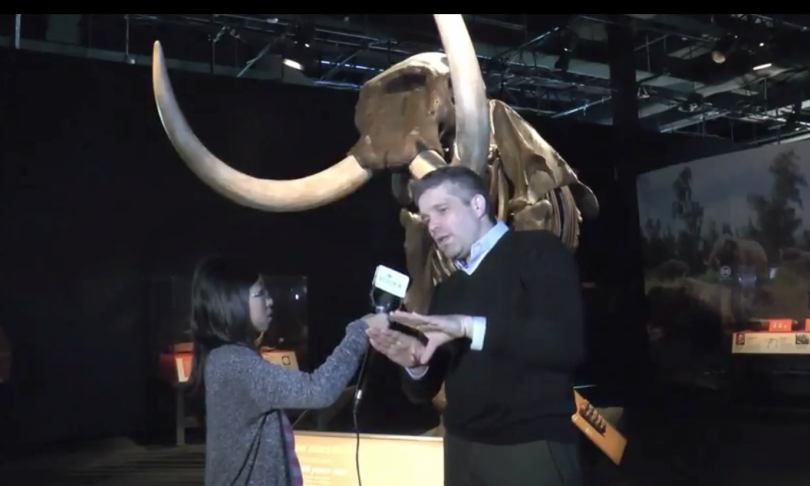
Dr. Hendrik Poinar is explaining the difference between the Mammoth’s and Mastodon’s DNA.
Contrary to popular belief, mammoths and mastodons did not evolve into modern-day elephants. “So what happens is you have an Asian offshoot of the elephant, and from that the mammoth evolved, both the Columbian and eventually the Woolly mammoth,” Poinar explained. Basically, mammoths evolved from the same ancestor as the elephant, the Primelephas, which lived about five million years ago. The earliest known relative of the elephant and the mammoth was a pig-like animal called the Moeritherium.
Another star of the exhibition is professor Daniel Fisher from University of Michigan and also the guest curator for this exhibition. The exhibition took three years and a lot of detailed, hard work to come together, which includes corresponding with people all over the world, gathering parts of the exhibit bit by bit, and working with companies that produced some of the life-sized reconstructions of animals. The list goes on.
“The most challenging part was how to pare this down to not have too many things so that it was too big and no museum would have space for it,” Fisher said. The exhibition was huge and it was hard to imagine that it could be any bigger!
Within the exhibition there were interactive activities, interesting videos and panels of information, but what attracted the most attention had to be Lyuba. Lyuba is the best preserved mammoth that has been found so far. Discovered by the Nenets people, the scientists guess that she was approximately 30-35 days old when she died. Her name means “love” is Russian, and indeed,Lyuba is loved by all, including Dr. FIsher and a ten-year-old visitor–—Rachel Martin.
“My favourite part is Lyuba; there could still be some fur on her, pieces of DNA, and some nails,” Rachel said.
Dr. Fisher likes her because “she was so interesting as an individual specimen and it was such a great experience to spend time with the indigenous reindeer herders, the Nenets people in Northwestern Siberia, who found Lyuba and who welcomed us into their home.”

David Sugarman explains the Mammoths and Mastodons found in southern Ontario.
As we exited the exhibition, I saw a big map southern Ontario. The map marked where mammoths, mastodons and other proboscideans were found. I got a chance to interview David Sugarman, a researcher at the Ontario Science Centre, who created the map for the exhibition. Sugarman explained that Southern Ontario is a site with many discoveries of mastodons and mammoths. He explained that this is because there is more farmland down south and therefore easier for a farmer to dig up a bone accidentally.
This event was stunning; from the life-sized models to little Lyuba I enjoyed all of it. It is a pleasurable experience, and if I were you I wouldn’t want to miss it!