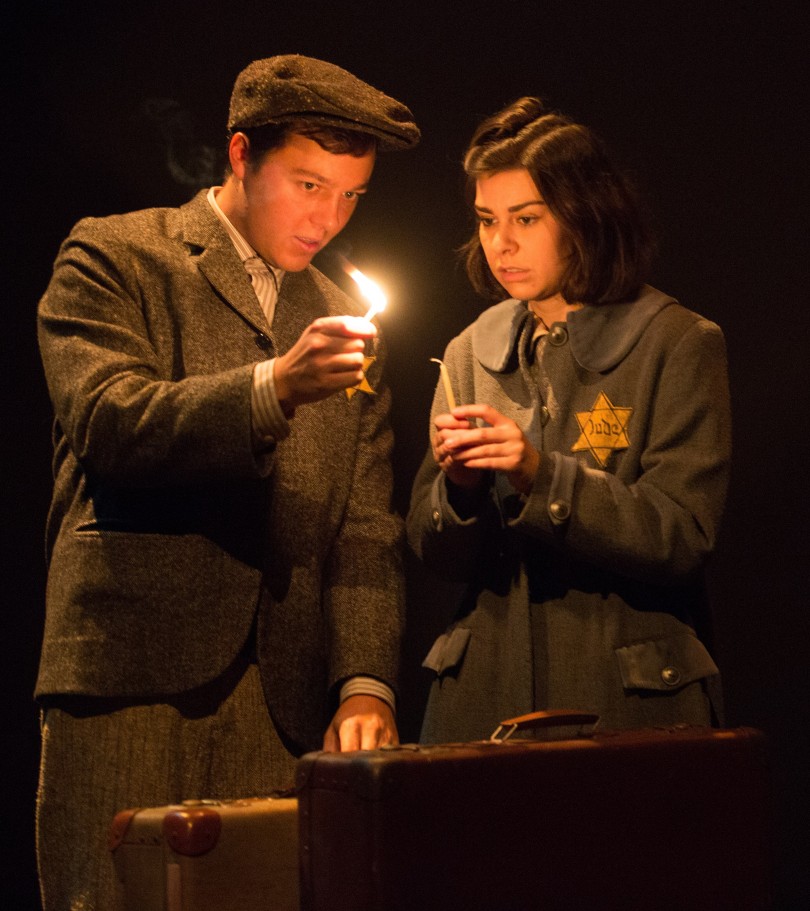


The Second World War was a time full of tragedies and unbelievably horrible events, such as the Holocaust. The Holocaust was an event from 1933 to 1945, where eleven million people were killed by a German group of people called the Nazis, led by Adolf Hitler. Out of those eleven million people, six million of them were Jews, and 1.1 million of them were children. Unlike Anne Frank, a Holocaust victim who is known worldwide for her famous diary, Hana Brady’s story was unknown to the world until its discovery in 2000. Hana was only 13 when she died. On October 8, 2015, we experienced the harsh life of Hana Brady.
When we entered the theatre, there were already a lot of people filling the seats and making themselves comfortable for a heartbreaking play. Hana’s Suitcase takes place in the Children’s Holocaust Centre in Tokyo. There was a Japanese-style door and a screen with Japanese words, and floating in the air were two interesting shapes that seemed to fit together.
The lights dimmed and the play began. The curator of the museum, Fumiko Ishioka, and two other children, Akira and Maiko, embarked on an adventure to find out as much as possible about the mysterious suitcase of Hana Brady for their exhibition. They overcame challenges and struggled to find more information about Hana from all kinds of Holocaust museums from around the world. Many times they were let down, and they were close to giving up. Finally, they regained their hope. Fumiko planned a trip to Auschwitz for some information and they hit the jackpot! They found out that Hana’s brother, George Brady, was alive in Canada, and could give them information and pictures of Hana to display in their exhibition. There was also some bad news. They figured out that Hana was not alive. They sent a letter to George Brady, and he replies and tells them Hana’s story. They acted out his long letter at the same time as Fumiko read the letter to the children. The letter described the hard times of discrimination that their family lived through, and things got worse and worse. Their parents were sent away, and then George and Hana were sent to camps, and then finally Hana was brought into the gas chambers, where she took her last breath.

The play was really well-rehearsed and it went really smoothly when the characters from the different time periods talked at the same time.
Caroline Toal, the actress that played Hana, really liked how Hana is hopeful throughout the whole play. She never gave up on her dreams. Toal thinks Hana somehow had so much hope, never giving up on looking for her parents while constantly doing things to keep her hope up.
We interviewed one of the audience members, Briana Brown. “I loved the play,” said Brown. “I thought it was wonderful [because] it’s talking about something really important in a way that is very personal.”
Brown believed that the use of humor was really wonderful. “There were a lot of moments when the content is so dark, then you wonder if you can keep watching it, then there would be some moments of levity that follows that makes you keep on watching the story.”
Her and our favourite character was Akira. He was very funny and he always got the laughs. He lightened up the play when it got too dark.
This was a very inspiring story about a 13 year old girl who had so much hope in the face of overwhelming horrors during the war. We experienced the (almost) impossible life of Hana Brady.