
 How big is the universe? Well, did you know there are more stars in the universe than there are grains of sand on this planet? We live on Earth, as you might know. The Solar System consists of eight planets and one star. Now think about how big Earth is. Multiply that by about 500, not even including the sun, and you have the mass of the Solar System. How big is that? That is just a small dot compared to the Milky Way Galaxy. And that’s not even the end. There are clusters of galaxies, and our local cluster is a water drop in the biggest waterfall in the world. The universe is a big place indeed!
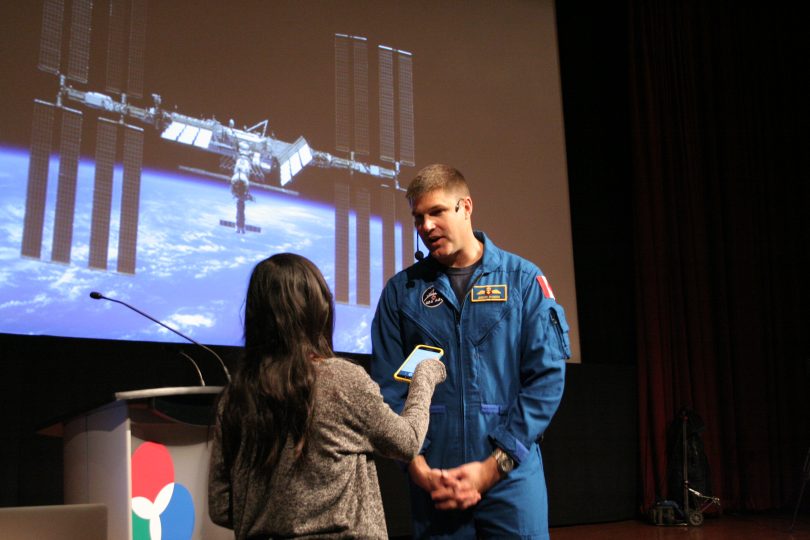
“We have to figure out better recycling technologies and more reliable technologies so we can get further away from Earth safely,” said Lieutenant-Colonel Jeremy Hansen during his inspirational talk at the Ontario Science Centre. Humans haven’t flown much farther than our own moon, so we have a lot of exploring ahead of us!
 Jeremy Hansen is an astronaut-in-training associated with the Canadian Space Agency. He told us his story of becoming an astronaut—all the hardships, adventures and lessons he learned along the way. His biggest message was to be yourself and to believe in yourself by setting goals.
“Once you set a goal, the only thing preventing you from making the amazing journey towards that goal is whether or not you decide to believe in yourself. Ultimately, that is what it comes down to.”
 Jeremy Hansen became an astronaut by following his goals and realising that he wanted to do what Neil Armstrong did—land on the moon. His father told him about a program called Air Cadets, and Hansen joined eagerly at age 12. He finished Air Cadets and earned his license to fly a fighter jet at age 17, then achieved his childhood dream by being recruited to be an astronaut in 2009. Now he works in Mission Control, communicating with the International Space Station.
After his inspirational talk, Hansen guided us on a simulated Mission to Mars. There were two separate parts: Mission Control and aboard the spaceship. On the spaceship, each student was responsible for a certain task or experiment. For example, Life Support tested water acid level to see if it’s safe to drink. The spaceship launched to Mars to replace Mission Control, which is the first crew that has been there for the past two years. Mission Control receives the test results and help coordinate the spaceship’s landing.
The overall experience was mind-opening. The Ontario Science Center did a great job making the simulator realistic, and Jeremy Hansen is a very motivational speaker. I wonder how many students changed their mind about their future profession and decided to pursue the career of an astronaut?